
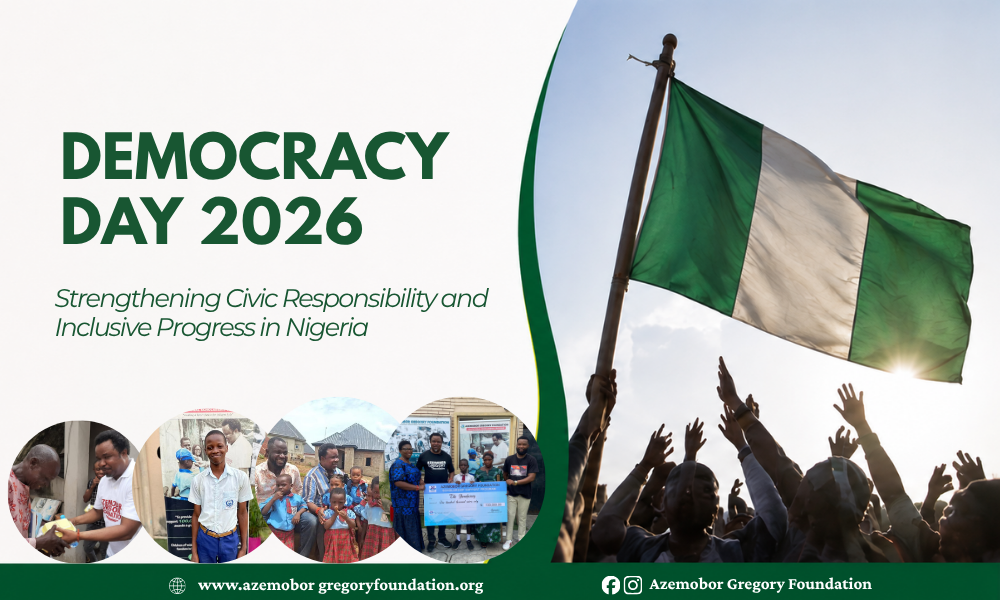
Azemobor Gregory Foundation marks Democracy Day Nigeria 2026 as an important moment to reflect on civic responsibility, governance accountability, and national development in Nigeria. Democracy is not only about elections. Instead, it is about how citizens and leaders work together every day to build a fair and stable society.
In Nigeria today, many people focus on political outcomes. However, democracy also depends on everyday actions such as participation, awareness, and responsibility. Therefore, every citizen plays a role in strengthening the system.
Furthermore, the Azemobor Gregory Foundation supports initiatives that encourage civic awareness and community engagement. As a result, more people, especially young Nigerians, are beginning to understand their role in shaping governance.
Civic Responsibility Through Azemobor Gregory Foundation
The Azemobor Gregory Foundation continues to promote civic responsibility through education and community programs. For example, the foundation engages young people in discussions about leadership, accountability, and social development.
In addition, these programs help citizens understand how government decisions affect their daily lives. Meanwhile, this awareness builds stronger participation in democratic processes.
However, civic responsibility is not only about knowledge. It also requires action. Therefore, the foundation encourages people to take part in community development and local decision making.
Youth Engagement and Democratic Development
Young people represent a large part of Nigeria’s population. Consequently, their participation is essential for democratic growth.
The Azemobor Gregory Foundation focuses on youth empowerment because it believes that leadership begins with awareness. For instance, programs that support education, mentorship, and community service help young people build confidence and responsibility.
Moreover, when youth participate actively, democracy becomes more inclusive. As a result, governance becomes more responsive to real community needs.
Nevertheless, challenges such as unemployment and limited access to opportunities still affect participation. Even so, continuous support and education can improve engagement over time.
Governance Accountability and Civic Awareness
Accountability is a key part of democracy. Without it, trust in governance weakens. Therefore, citizens must remain informed and engaged.
The Azemobor Gregory Foundation encourages transparency by supporting civic education initiatives. In addition, it promotes discussions that help communities understand their rights and responsibilities.
Meanwhile, government institutions also have a duty to respond to citizen concerns. However, this only works effectively when communication between both sides is strong and consistent.
As a result, stronger accountability leads to better governance and improved public trust.
Role of Civil Society in Nigeria
Civil society organizations play an important role in supporting democracy. They act as a bridge between citizens and government institutions.
The Azemobor Gregory Foundation contributes to this space by supporting community development programs that focus on education, empowerment, and social inclusion.
Furthermore, these efforts align with global democratic standards promoted by organizations such as the United Nations, the Independent National Electoral Commission (https://www.inecnigeria.org), and the World Bank.
Therefore, civil society remains essential for long-term democratic stability.
In conclusion, democracy becomes stronger when people stay informed, participate actively, and hold systems accountable. As a result, Nigeria can continue building a more inclusive and responsible society.